Pages

Monday, June 2, 2014

Unit 4, the Final Unit; The School Year Ends

For the final Food for Thought action project, we talked about current farming techniques and what could be done in the future. We created a poster showing all four units. We had four groups and each group drew a road. Around it are drawings representing the unit each group of students were assigned. I think that the biggest challenge was making sure the roads of each drawing lined up when we put it together. We took inspiration from The Beehive Collective’s, ‘True Cost of Coal” because it shows a perspective of the true cost of coal. The poster shows us the beginning of agriculture and then it goes into a polluted world which ties into a future goal of clean energy. This relates to you our poster about food because our poster is showing what food went through and through out the poster we are showing what we hope food will look like in the future. The rewarding part of this project was seeing how the whole picture came out. I think the future of food is using lots GMOs because the industry will sell what tastes good and the GMOs will make certain food tastes good.

GS, VG, & DP.  "Unit 2 Illustration" 2014. GCE High School.

GS. “Food for Thought.” 2014. GCE High School. (Collaboration Project)


In this work of art, multiple themes and elements represent different things in our unit 2 picture, these events took place throughout the 1400s- 1700s. Unit 2 was all about death and how the industrial revolution and World War II changed our food system. As the road of time goes through hardships and death, it lowers to the bottom of the page because the slope is showing how that period of time was very hard for people. On the left hand side, there’s an animal kingdom representation of Feudalism; going by an order of importance with kings, followed by lords, knights, and peasants. The lion represents the lion, the cheetah represents the lord, the crocodile represents the knights, and the fly represent the peasants.

In the bottom corner, a map is shown, also indicating where the triangular trade took place. In the corner opposite of the map, “cash crops” are shown, each one being a stalk with the U.S. currency symbol ($) on it. Cash crops are any crop that is considered easily marketable, for example wheat or cotton. On the upper side of the road we have many other details that represent other elements from this unit. A large body of water covers about a quarter of the page (top right) and invading ships represent colonization. Also near the ocean are the spores of the disease that caused the Irish potato famine, with a pile of harvested potatoes off shore and the purple colored spores (not meant to be historically accurate) contaminating them and moving on to the ships

Further up the page is a small peninsula that harbors other trade items and crops, featuring cotton stalks and tea plants. Monoculture is the cultivation of a single crop in a given area. To show a monoculture, near the road and a small river from the ocean is the exact same kind of potato, row after row, after row.
Another structure near the river is a plantation causing mild pollution and minimum grass and plants near it. Another structure near the river is a plantation, causing mild pollution and minimum grass and plants near it. That’s all the drawing has to offer but the multi colored waves of the ocean can truly sweep those ships away. A plantation is a large farm or estate, especially in a tropical or semi- tropical country, on which cotton, tobacco, coffee, sugar cane, or the like is cultivated, usually by resident laborers.
You will see the the finishing product with everyones drawing put together as we demonstrated each unit. Unit 1 focusing on the beginning of agriculture and colonization and how different foods were found and domesticated. Unit 2 focusing on monoculture, death, and colonization. Unit 3 focusing on current food industry and the way that our food is made and treated. Finally, Unit 4 focuses on the future of food and how it has changed over all 3 units.

Sunday, June 1, 2014

GMOs Anti vs. Pro

The end of the school year inches closer and closer, with only a few days left there is but one assignment to complete, the final Action Project for my Food class. It's about unit 3, it's about genetically modified organisms, and it's about whether or not they should be allowed in our environment. I must admit, at first, finding research for how GMOs are beneficial was hard, but I soon found a reliable website you may know. Sources will be mentioned in the slideshow. Under the circumstance of the scenario being a type of voting booth, with a debate to convince people to vote for one side or the other, it seemed like anti-GMO had the upper hand. Luckily enough, I was able to gather enough resources to say otherwise. Multiple, reliable, and proven facts are displayed in my slideshow below and I think what made me most proud was using the information, displaying the way I did. I'm not much of a bragger, but read for yourself and see if you're convinced.

Tuesday, May 27, 2014

Homemade Dishes vs. Restaurant Meals

 As the final Action Project for this term, and ending the school year, I've just got a few things left. To start off, let me talk about the unit, unit 3. This final unit (that I'll be covering anyways) is revolved around the idea of birth. We've studied about the green revolution and slightly discussed some  matters with GMOs, but that focus is for my other class, which I will make a separate post about. This Action Project was for us to create a food review, but not any review, one of a restaurant dish and a homemade one. More information about this will be shown below in a more in depth review. I hope you enjoy reading and try not to get too hungry.
Pannenkoeken restaurant omelette VG, 2014
*note, the home cooked omelette photo was lost but also was identical in
appearance (tomatoes mimicking the red bacon pieces and so on) *

This is a written food review about a homecooked meal, versus a dish prepared at a restaurant. The specific place I ate out is a breakfast joint called Pannenkoeken (Pan•co•ee•ken). It was on May 18th when I went to the restaurant, but since it was packed I ordered my omelette to go. On the same day later on, with the assistance of my older brother, I made another omelette at home but it didn’t feature the same ingredients.

In the comfort of my own home I began to dine on the folded, golden yellow, omelette from Pannenkoeken. There was bacon which gave out a vivid and distinct red, with a side of lightly colored hashbrowns (which, evidently, were brown). Since it was a “to go” dish, it wasn’t exactly served “hot n’ ready”. As for smell, however, you could detect a hint of melted cheese but the bacon really took over. The compact omelette will sound mushy and feel soft in your mouth as the potent bacon will dominate your -now slightly salted- taste buds, leaving the eggs to go unnoticed, but the cheese adds a small bit of sweetness. This bright omelette seems to be from fresh produce due to its similar taste when I compare it to the homemade omelette. For about $8.50 and a 30 minute wait, I received a great omelette that filled me up for a few hours.

A few hours after my restaurant meal, I started to create my next breakfast… at four o'clock in the afternoon. Using 3 eggs, to make a larger omelette to share my brother, I first whisked them. Coconut oil was added to the frying pan for some flavor and some pan-sticking resistance. As the oil settled the eggs were poured in, then during the frying some herbs were added, since we had no other ingredients. Cherry tomatoes, oregano, and paprika were the additional ingredients. As it was cooking you could hear the sizzling in the air and the omelette was steaming up. After about 25 minutes (on low heat) of cooking, it was ready to eat. I ate the light brown and vivid yellow omelette with vibrant tomato bits on top. For some odd reason, the dish smelled like chicken… perhaps it was because I was eating one of their -failed to develop- unborn children. The omelette also seemed to be smooth, yet bumpy, and while I ate it, it sounded like, well… an omelette being eaten. As for the taste, the tomatoes complimented the egg and coconut oil, making a rather sweet and possibly bitter taste. I know that all the ingredients used are already organic and healthy because that’s the only type of food my mother would ever purchase.

Out of the two delicious omelettes, I think I’d have to say I enjoyed the one from the Pannenkoeken diner more. This is probably because of the bacon and also the fact that there was just more to eat, with the hashbrowns and a side of toast. The homemade omelette was great, especially considering the lack of ingredients available, however if you pin anything up against my favorite food, bacon, then I’ll probably favor that one. As they’re both omelettes, both had the same base ingredients; well whisked eggs. I think I might recommend the homemade one, with its variety of herbs, it can be healthier. However if you’re a fan of meat on your omelette, (including bacon) then you probably already know what you want.

All things reviewed aside, in this unit (unit 3), we read an excerpt from Pollan’s “In Defense of Food” which mentions 5 food transformations in our modern diet. These 5 include: Whole Food to Refined Food, Complex to Simple Diets, Quantity over Quality, Grains and Seed over Leaves, Never Straight from Nature (or Food Culture to Food Science). These were the changes that happened, but I don’t expect you to know them by heart, so I shall explain them to you. We went from eating whole grains to refined grains, which have less nutrition, even if they are easier to digest. Then there’s the complex diet that we used to have, to a simple one today that consists of less than 10% of what we used to eat. After that, the modern diet will have quantity over quality, where we eat more food now just to gain the nutritional quality of one “side-dish” back then. And nowadays, humans will consume more grains and seeds than leafs, which actually isn’t too great of a change, they’re just easier to harvest. Finally, nothing comes straight from nature, from a food culture, to a food science, a majority of things we eat have already been modified by scientists today. Coming from this angle of thinking, I actually (surprisingly) haven’t found a connection between any of these. My mother is a good researcher and a naturalist, so when it comes to healthy food, she will dig down deep to find the buried treasure. Even the eggs were as healthy as can be, with pasture-raised, which means that each chicken had free open space (while still being contained) and actually got to see the sun. These chickens were also humanely harvested, so their death was quick and unnoticed, so they didn’t have to suffer any pain. All this is accomplished while being organic, no growth hormones, natural food, and not genetically modified at all. Granted I may not have all the information about the Pannenkoeken omelette, but seeing as how it tasted similar to my homemade one, I can come to a safe conclusion that it’s not processed, or artificial. That same organic taste and essence is near impossible to replicate, unless you actually have that natural or organic ingredient. So overall, both are great organic omelettes that I’ve enjoyed.

Thursday, May 15, 2014

Where the Watermelons Are

Briefly after the first Action Project, in which I studied the origin of a product of my choosing, a second one arose. What’s this one all about, well, where food really comes from. In Food For Thought, we were assigned to choose one product or produce and create a Prezi (online application that creates presentations) about all the different factors about how it’s grown, processed, and transported. The unit itself asked us how death can be related to food, and going in depth about this there are plenty of environmental impacts, plus ones that affect humans as well. I chose a watermelon to research because I thought it was unique; and it was a fresh fruit that nobody chose. So far, the Prezi will explain most things but as of how this changed my eating habits, I’d say it generally stayed the same, why? Because I already eat healthy, locally grown and domestic organic food.

Tuesday, May 13, 2014

Cupcakes And Substitutes


In my Food class, a math and science course for this term, our second unit revolves around cooking and other chemistry. The main focus was acid-base reactions. An acid-base reaction is when something of a low pH (power of hydrogen) which makes it acidic, mixes together with a basic/alkaline high pH substance, neutralizing each other. For the action project, we were to determine a substitute for baking powder, which contains a base, an acid, and corn starch which will delay the process of reaction. The substitutes chosen were egg whites, as a base, and lemon juice, for an acid. These two ingredients have opposite pH’s, with the egg white’s having 9 and lemon juice having a 2. The higher a pH is, the more alkaline the substance is, and the lower it is, means it’s more acidic. The pH scale also goes by increments of 1, ranging from 0 to 14, with a difference of ten times between each one. All that aside, I’d say there was a particular moment that I am more proud of. This instance was when DNR (another blogger of C2 labs) and I created frosting for the cupcakes; however rather than using powder sugar, we used the fine sugar grains instead. This made the frosting very, very sweet and quite grainy; some may say it was a sandy texture. For more details about this project, please read my lab report below.


The Controlled Bakery of Height


1. Introduction

In this second action project, we need to find a substitute for baking powder using 2 other ingredients. The two that my group, consisting of myself, GS, DP, and NVA, decided upon were lemon juice, with an acidic pH of 2, and egg whites, which had a basic measure of 9 on the pH scale. This would give out an acid-base reaction due to the contrasting pH measures. During the reaction, carbon dioxide is produced and the bubbles make the cupcakes rise. The main goal was to test whether or not we’d get the same reaction as baking powder; we measured the height of two groups of cupcakes, the control and the experimental.

2. Research Question

What ingredients give off an acid-base reaction to replace the leavening agents?


3. Hypothesis

If the leavening agent is replaced with egg whites and lemon juice, then the cupcakes will still rise, but probably not as high as the original control group cupcakes.


4. Materials
(for 6 cupcakes, excluding the leavening agents or substitute ingredients)
  • Sugar (½ c)
  • Butter (¼ c)
  • Eggs (1 egg)
  • Vanilla [extract] (1 tsp)
  • Flour (¾ c)
  • Milk (¼ c)
  • {control group} Baking powder (⅞ tsp)
  • {experimental group} Egg whites
  • {experimental group} Lemon Juice


5. Procedure

For Control Group:

Follow the process shown on instructions, which read:

  1. Gather materials
  2. Preheat oven to 350º F
  3. In a medium bowl
    1. Cream together sugar and eggs
    2. Beat eggs one at a time
    3. Then stir in vanilla
    4. Combine flour and baking powder, mix until smooth
    5. Add milk
    6. mix once again until light creamy texture arises
  4. Pour batter into cupcake molds/holders
  5. Bake for 20 minutes


For Experimental Group:

  1. Gather materials
  2. Preheat oven to 350º F
  3. In a medium bowl
    1. Cream together sugar and eggs
    2. Beat eggs one at a time
    3. Then stir in vanilla
    4. Combine flour to batter, mix until smooth
    5. Add milk
    6. Mix once again until light creamy texture arises
    7. Add (substitute ingredients) egg whites and lemon juice
  4. Pour batter into cupcake molds/holders
  5. Bake for 20 minutes


6. Data

Cupcakes
Amount of Lemon Juice (TSP)
Amount of Egg Whites (TSP)
Height of Cupcakes
1
1/8
0
3.9 cm
2
0
1/8
3.5 cm
3
1/32
3/32
3.5 cm
4
1/16
1/16
4 cm
5
1/64
7/64
3.1 cm
6
7/64
1/64
3 cm
Control Group
-
-
4.7 cm

7. Graph
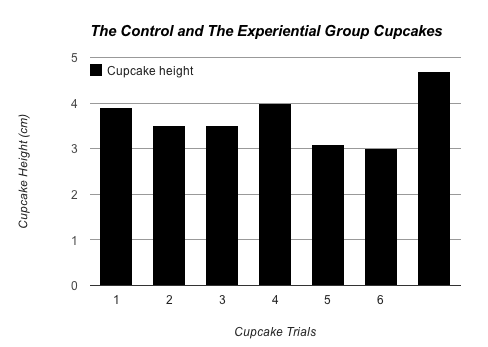
Screen shot 2014-05-13 at 4.09.29 PM.pngThis graph shows the height for each cupcake trial

8. Recipe in Metric

The following table is what I would like to submit to the magazine as my favorite cupcake from the bunch.

Ingredients
Amount in cups/tsp (or egg)
Amount in mL
Sugar
1/12 c
20mL
Butter
1/24 c
10mL
Eggs
1/6
-
Vanilla (extract)
1/6tsp
0.8333...mL
Flour
3/24c
30mL
Milk
1/24c
10mL
Lemon Juice
N/A
N/A
Egg Whites
1/8tsp
0.625mL


9. Conclusion
Overall, this testing was, in my opinion, a complete success. The cupcakes rose and my group was able to substitute the leavening agent, baking powder. As of the hypothesis, it was proven as well, stating that they would rise but lower than the control group, and the data proves this. Also, I’d submit the second cupcake because of how much sweeter it was than the rest, it was actually flavorful, unlike the rest. In the end, I think that because there was such a large difference between the 2 ingredients is why they reacted so well.

Friday, April 25, 2014

The 10 Companion... Vegetables?


In Food, a math and science course, we are studying food as a science. In the other class, Food for Thought, we talked about the history of food. The Food class is a freshman class that’s integrated with the math and science of fruits and vegetables. We learned about plant ecology, how certain plants are companion plants, and how those plants assist each other. An example is when they share nutrients or give shelter. At times they will benefit one another like warding off insects.
The elements of a healthy soil environment include nitrogen, phosphorus, and potassium. These are 3 macronutrients that help in the growth of the garden; nitrogen assists in gathering protein and green coloring with the chlorophyll. There are also different types of dirt, alive and dead. The live dirt is rich in organisms, compost, mulch (anything like other scraps of plants), and has a darker color of brown than other types. The dead dirt is much paler and has pests that don’t benefit the ecosystem the way that the dirt or the plants may need. It may also be hard to break apart, unlike alive dirt which may be fragile and falls apart, but has many more nutrients.
This Action Project is meant for us to study the optimal situation for 10 vegetables of our choice (within the options inside a catalogue) and plan out, like a blueprint, a garden. Along with a detailed sketch, we have the option of actually growing them. My 10 products of choice are; the dragon carrot, iceberg lettuce, nutri bud broccoli (yes that’s the actual name), rudolf radish, renegade spinach, scotland leeks, yukon gold potatoes, legend tomatoes, black beans, and some maize/corn.
All these plants interconnect and share similar nutrients. Carrots grow well with lettuce and tomatoes. While tomatoes delay the growth, they assist in the flavor, by adding to it. Lettuce will grow well with radishes and beans, and beans also go with corn and spinach (if they are broad beans). Beans themselves are a nitrogen fixer which aid in the gathering of nitrogen like converting it into nitrogen compounds that plants can absorb. Some of these compounds include nitrate, nitrites, and ammonia. Plus, broccoli grows well with potatoes. Broccoli loves calcium and even though there aren’t any herbs to help with that, the potatoes add flavor similarly to the tomatoes. Then corn can also grow as a companion plant with the potatoes. They also resemble characters I like through either obscure references or mistaken identity.
updated garden.jpg
I designed the garden in a circular formulation because all my plants interconnect with each other to assist one another. My backyard would already sustain these because my mother already has a garden there. However I do need to add a nitrogen and phosphorus booster. I need 1.8 lbs of blood meal, which adds nitrogen, and 0.72 lbs of soft rock phosphate, that is a phosphorus booster. I figured it out with these calculations:
Test
Result
Parts per Million Equivalency Chart
pH
pH 7 neutral
----------------
Phosphorus (P)
P2 adequate
20
Potassium (K)
k3 sufficient
600
Nitrogen (N)
N1 deficient
10


Nutrient
Product
Quantity
Nitrogen
Blood Meal
1.8 lbs

Fish Meal


Cottonseed Meal


Feather Meal

Phosphorus
Soft Rock Phosphate
o.72 lbs
Potassium
Sulfate of Potash
Not needed


Nitrogen:
36% of 5
36% x 5 = 1.8


Phosphorus:
36% of  2
36% 2 = 0. 72


I obtained the 36% percent through a calculation. This was done by comparing my area of my garden compared to the recommended amount for a set area. So my garden was just 36% of that size that requires 5lbs of blood meal and the two pounds of the phosphate.

  Overall, I’ve learned much through this unit. The main reason why I did the soil test was to check if I needed any thing, like nitrogen (N) and phosphorus (P) boosters such as blood meal and phosphate. I might actually plant the garden after the project, but it also might take up a lot of time, so there’s no guarantee there. Thanks for reading and I hope you enjoyed.