Pages

Sunday, March 22, 2015

Mind the Gap, and Watch Out for Cholera

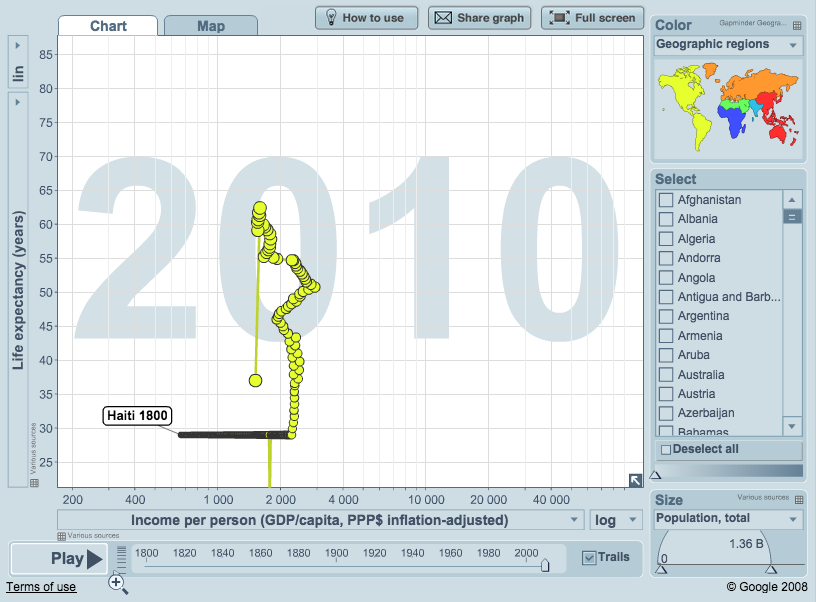
The last Action Project for the Disease class has us bringing awareness to any epidemic and how it's history as a great impact on how we've developed throughout time. Utilizing research from multiple, free to choose, sources, I chose cholera because it had many historical impacts, outbreaks, dubbed as a pandemic at some points, and is still relevant today. As you can see below, there's a full researched excerpt from a script that would've been implemented into an edited video. Unfortunately, I was not able to create any video due to technological restraints. It was a definite challenge to find representatives in the Gapminder World web app. Relations that were recorded between the many countries affected by cholera were scarce, with results that either didn't go back far enough, or unrelated factors. Right below you can see the script report for yourself, and thank you for reading.


There’s a disease that’s been around for more than 150 years, and it’s still running around today. Cholera is an immense disease that gives you diarrhea, abnormal cramps, extreme heat, loss of skin reformation, dry areas of the body that usually produce mucous, low blood pressure, rapid heartbeat, intense cramps, and even frequent thirsts. Multiple factors affect this disease too, and in many ways, reflects the status of a great number of underdeveloped countries today, who are the modern victims of cholera in this 21st century. These factors include contaminated water, polluted rainfall, poverty (unsanitary living conditions), low hygiene/poor sewage systems, and a crowded environment.
GapMinder Map VG 2015
During the mid 1800s, many countries such as Russia, Copenhagen, and England suffered from outbreaks of cholera. The third cholera pandemic in Russia was the most devastating, killing an estimate of one million people. England had it the easiest with an estimate of 616 casualties with a sudden outbreak, meanwhile Copenhagen had 4,737 deaths due to the disease. Closed off or crowded living spaces were common in the 1850s due to the poverty, there was a very clear separation of who was rich and who was extremely poor, especially in england. Russia had the most victims probably due to a lack of hygiene, and with a population at about 60 million at the time, it may not be the biggest place, but in comparison as a country (as opposed to a continent), it’s quite a large place.
GapMinder Graph VG 2015
Ways we’ve combated cholera is by having advanced sewage systems and cleaner living environment. Developed countries like the United States have practically abolished cholera since the last outbreak it’s had back in 1911, yet there are still unfortunate victims of this disease to this date. Underdeveloped countries such as haiti have lost thousands to this disease due to it’s economic status. As a poor country, it can’t afford the same type of medical care or sanitary programs as more financially able countries. During March 2014, Haiti had suffered from more than 8,500 casualties. When living in tight spaces or with a lot of people, cholera becomes even more dangerous with a higher likelihood to spread to others. On average, it can infect up to 15 people from a single person who is suffering from this ailment. Another way to put this is that the RĂ˜=15 (the R naught equals fifteen). Easy ways to prevent cholera (if you happen to be at risk for catching it) is to keep yourself clean; wash your hands often, and bathe whenever possible. It’s really the simple steps that help prevent this infectious disease along the way.

Works Cited

John Snow (1855). On the mode of communication of cholera. John Churchill. Retrieved 29 March 2011 (Wikipedia Reference)

Monday, March 9, 2015

Insomnia Instance - Fatal Lack of Sleep

The second Action Project in the Disease class, we look at a different criteria of diseases altogether: mental diseases. The unit itself went over the different aspects of mental diseases, as well as facts about our mind and how to determine a diagnosis. Unlike physical diseases (cancer, diabetes, etc.), mental disease need to align with certain symptoms, and usually more than one, in order to be truly diagnosed as the actual ailment. There was a wide variety of what we could choose from as long as it's covered in the DSM 5, a book that lists a great multitude of mental diseases and describes them with medical accuracy. Some of the options within the diagnosis book include schizophrenia, obsessive-compulsive disorder, and even alcoholism (addiction to alcohol, which can affect your body severely either with the addiction, or through the withdrawal). My choice was insomnia (also referred to as sleep-wake disorder), which is actually something many people tend to misinterpret.

From the DSM 5, I chose to study up on insomnia, a mental disease that basically renders an inability to sleep or having trouble falling asleep, not (as it is commonly misinterpreted) a mere unwillingness to sleep. Insomnia doesn't allow oneself to sleep unless very specific criteria are met, in other words, the sleeping environment needs to be perfect, and this can vary based on personal preference. Directly from the DSM-V (5), it describes insomnia as: Disturbed sleep, whether because of quality, timing or duration, can have many adverse health consequences. The most obvious concerns are fatigue and cognitive focus, but mood can be greatly affected, too. -DSM V (5). Insomnia results in fatigue, inability to focus or concentrate, poor memory, mood disturbance, daytime sleepiness, low motivation or energy, and increased errors or accidents. Due to no sleep, your brain has a lack of theta and delta brainwaves, so you never enter that restorative process of sleep. 
––––––––––––––––––––––––––––––––––––––––––––––––––––––––––––––––––––––––––––––
Rebecca Turner, The Man Who Never Slept: Ngoc Thai,
World of Lucid Dreaming (website) {click to enlarge}
"Insomnia also can keep you from performing your best at school or work. One study estimated that an employee with insomnia loses about eight days of work performance each year. For the entire U.S. workforce, this adds up to an estimated $63 billion in lost work performance due to insomnia each year." Thomas M. Heffron, Insomnia Awareness Day, SleepEducation.com

However, insomnia doesn't always affect everyone who has it, or at least not to the point of physically growing weaker. 
_______________________________________________________________________________________

Another part to this analysis is for you yourself to simulate it. Please follow this lesson plan below if you wish to have a taste of how it feels to be an insomniac, but on a minimum scale.


Why?
(GQ)
What does it feel like to have sleep-wake disorder, aka insomnia?
What does it feel like to interact with a person living with insomnia?
Time
How?
How will you initially experience these feelings?

At the end of this lesson, you will have:
  • Simulated the feeling of fatigue through direct instructions
  • Question yourself about what you truly believe the symptoms are (meaning myths or general ideas you may have heard of before)
  • Reflect upon how you would try to live with a live that has no rest
~
What?


Agenda
&
Content
What’s the process of you experiencing these symptoms (slightly)?

Starting off, you will begin the simulation by:
  • Blinking rapidly and consistently until eyes are tired•2-4minutes
  • Keep eyes open for an extended period of time, maybe even have a staring contest with someone•3-4 minutes

  • Reflect upon this initial question; What if feeling like this was my daily life? Just imagine if you felt tired and sleepy every single day of your life, and whatever you’re feeling right now is multiplied by hours, amongst days, amongst months. Soon you go more than a year without frequent or necessary sleep.
5-8 min


Closure
Reflection
  • (Writing) How might you respond differently to someone living with the disorder you studied?

My answer: “Since insomnia is a peculiar disease, it’s not exactly something you can be all to helpful with. Insomnia actually has instances of only being temporary, but it’s essentially something that can only be helped if you’re able to assist one’s environment to strengthen comfort, which encourages sleep.”

Materials
Yourself
Functioning eyes
Usable eyelids


––––––––––––––––––––––––––––––––––––––––––––––––––––––––––––––––––––––––––––––


  Now you've experienced the same thing an insomniac goes through a majority of their lives. To summarize, insomnia/sleep-wake disorder is a condition where you truly can't go to sleep unless your environment is past the conception of perfection based on your body's apparent personal preference. Many Americans today suffer from insomnia and while it's not always consistent, it can really have negative effects on your life by the means of extreme fatigue. You could lose a lot of productivity or performance skills just from not getting enough sleep, and sooner or later, a constant lack of rest can become fatal. It's even worse to drive mentally tired (from no sleep) than it is to drive intoxicated (drunk), and if you have insomnia, you're bound to be tired. Thank you for reading all the way through and now you know a little bit more about insomnia.

Friday, March 6, 2015

Japan's Censored Media

Forbidden Books comes up with a second Action Project, and this one is all about censorship. From a set selection, we were to choose one of the multiple historical events that happened in another country, countries like Brazil, Greece, Germany, and China, as well as plenty of others. Overall in this unit (unit 2, just to clarify), we went over dogmas, strong beliefs that can't necessarily be proven or disproven. Some examples of dogmas are including within some teachings of certain religions. Later in the unit, we went over how censorship comes in all forms when relating to censored content. I myself chose the Japan~Yokohama Mainichi instance where the Japanese newspapers were censored. During the making of this Action Project, it was tough to search for the right source material; at first, it was all scattered, with only slight references and hint to the Yokohama Mainichi censorship issues, but luckily enough, Wikipedia lists its sources and I was able to research using those (which you can see sited in the presentation down below.   More information is shown in the slideshow below, and I hope you enjoy.

Thursday, March 5, 2015

Introducing the Disease Class


Malinformed about melanoma? Then you might want to keep reading. In the first unit of the class called "Disease", we studied about physical diseases that affect the human body. Diabetes, cancer, and many others were chosen in this free of choice Action Project, which centered around body affecting ailments (also known as: Physical diseases). A challenge for me was finding someone to interview who either is a survivor or a patient of skin cancer (or any variation of it). It was difficult to find someone, and harder to contact, so as an alternative, I used true stories from SkinCancer.org, specifically this page: http://www.skincancer.org/true-stories. I was proud of my visual which you will see in the full report below due to ti being completely digital using Google Drive's Drawing application, which is available as a preset under "more" option when making a new file. In short, alongside Jerry Penacoli's survivor story of melanoma, I speak of the traits, factors, risks, and treatments of skin cancer in general.

Cancer, the abnormal growth of cells in a particular area. Melanoma is a serious type of skin cancer that Jerry Penacoli, host of the Nightly Entertainment show, managed to get through himself. He noticed a brown freckle on his inner thigh that wasn’t there before, and overnight, it drastically expanded and he then knew this wasn’t natural. When he went to get this checked out, he was diagnosed with Melanoma, and was put into a surgical operation 4 days after this. 2 surgeries were in order, one to remove the cancerous growth, and another to remove 22 lymph nodes because the cancer could have spread to them.

VG, The Human Body, 2015
Skin cancer is caused from a multitude of reasons, one being over exposure to sunlight. Now when most people think of skin cancer, they won’t think that it affects the largest organ in the body, but the integumentary system; which is also known as our skin, is indeed an organ. Lymph nodes distribute white blood cells throughout the lymphatic system, and those white blood cells fight off viruses, however they may get infected by diseases such as cancer. Skin cancer really happens wherever the sun can shine and it happens to anyone of all races and genders. While anyone is at risk, lighter skinned people are more vulnerable because of their sensitivity to the harsh sun, but there is no increase or decrease in risk based on age or gender, merely exposure to a large amount of sunlight (a very large amount). This doesn't go to say you should stay out of the sun because vitamin D is an essential vitamin, this only means you should moderate your body from the sun, or even artificial UV rays such as tanning beds.

A precaution to be sure of in regards to skin cancer is to look for new, unnatural looking growths that may seem like birthmarks at first glance. In a single night, these newly found marks will grow and become more dangerous as they expand and spread. Different types of UV rays affect your skin as well, with UVA aging the skin much faster, and UVB basically burning your skin. Luckily enough, cancer is not contagious in any way whatsoever, so it’s easy to prevent, yet it is tough to combat. As most other cancers, skin cancer has multiple stages, and with each number growing tells how serious, dangerous, or large it may be. Treatments to cancers like melanoma include removing the tumour and anything that may have been contaminated or affected by it. Skin cancer is no doubt one of the worst diseases, starting out as something easily disregardable and possibly growing in a practically invisible spot of the body.

Friday, February 13, 2015

Forbidden Books and Socrates


The class Forbidden Books is in this term, and the Action Project this term will make you ask all sorts of questions. Starting off this unit is studying philosophy, and we also looked into Socrates. Now Socrates was a philosopher, philosophy is the love of knowledge, so Socrates always wanted to learn more. The Socratic method is a form of thought that always makes us question what something is, to know that we know nothing is key. This Action Project was to use philosophy to analyze (and choose) a topic from a set list. This was to bring out our inner Socrates and philosophize about some of the most concrete beliefs. I chose courage since it really stood out to me from the others, it’s not exactly like you’d question courage all that much. Something challenging was probably having the recording ready, there wasn’t enough time or availability for me when attempting to record the video skit of the script that you can see a transcription for down below. Thank you, and I hope you enjoy.


Courage

Location: United Polis of Garcicia
Characters: Veracule (VG) & Arvaki (DP, fellow GCE Blogger)

A: Yassou (A Greek greeting) Veracule, guess what I managed to slay in the new dungeon? A chimera! Hah, pretty courageous, huh?

V: Well, no… not unless you have a phobia of those multi-mutated-beasts. I’d say you were brave in that situation.
A: Uhm, what? Bravery and courage are the same thing, it doesn’t matter.

V: You’re putting courage and bravery under the same category? That’s odd.

A: Chyeah, both have you completing a great feat, right? So they’re the same.

V: Actually, you’re just talking about achievements in general. But courage and bravery are two very different traits my friend, don’t you think?

A: Courage and bravery both make you surpass difficult tasks.

V: Bravery has you fighting against the odds. Courage is the will to go and fight against you fears, natural fears, true phobias, personal trauma.

A: But… aren’t they both the drive to pass something intense?

V: That’s motivation.

A: Ok then, what do you call courage?

V: Well, you see, courage is something all on it’s own, because it goes for many things, not just a single fear. Courage is that passion to fight for what’s right, the instinct to go through any obstacle, the power to believe in yourself and face any challenges that await you. Courage is to fight without fear. Courage is to have no fear.

A: I see… but, then bravery--…?

V: Is when you know it’s going to be an uphill struggle, deprived of any advantage or even fairness, but you still want to reach towards your goal.

A: So… does that mean courage is a fuel without fear, while bravery is a fire without doubt? I think I see now.

Wednesday, January 14, 2015

Indian Jones Analysis of the Lost Ark

The final Action Project for this term in my Ollywood movie critique class. This project was more than just a review but an audio movie analysis to be specific. An analysis is different then a regular review, it will feature less opinionated content, and more literal evidence. It was fairly challenging to write out a good script for my review which is about Indiana Jones Raiders of The Lost Ark, it took time to decide which scenes to use considering how captivating of a movie it was. I feel like I learned how much more a movie can bring in terms of content, because editing, music, and effects really do make a movie what it is. Down below you can see my script for this audio recording as well as the sound itself.

 
Hello, and thank you for tuning into my analysis of Indiana Jones: Raiders of the Lost Ark. This movie is an Action & Adventure film, directed by Steven Spielberg in 1981. The lead role features Harrison Ford as Indiana Jones. I will critique the film for elements of post-production including editing, special effects, soundtrack, and sound effects. I will analyze those elements through the feminist approach, a contextualist approach that focuses on the female lead or character of the story, as in how they’re depicted or what they do throughout the film. The movie takes place in 1939, during WW2 and women’s rights were still a relatively controversial topic as it was such a young and new idea An empowering female figure during this time was essential in conveying and supporting the message of women’s rights.

Indiana Jones, artifact reserves member, archaeologist, and professor. After returning from his latest expedition, which had him traversing through a great jungle, he is informed of the lost ark, a historical artifact that’s almost that of Pandora’s Box. The film takes place in 1939 when World War II is occurring and the Nazis want the destructive power that legends speak is inside of the Lost Ark. It is up to Indy to retrieve the treasure and make sure that it is properly preserved… too bad he didn’t realize how much trouble it would be to do so.

In the introduction of the movie, just before the iconic rolling boulder run, we see multiple booby traps. One of the traps we see, utilizes a pressure plate to launch an arrow. In one of the scenes, Indiana Jones activates it with a log and through the use of the before-action film cut, the scene cuts to an arrow that shoots out and zooms right into the log. The following scene, we see Jones’ companion, who went alongside him in the tomb, hunched still, staring at Indiana Jones and the scene cuts to Jones as he barely avoids the traps. This was achieved through the look-off film cut.

Later in the film, we meet Marion, who has some connection with Jones and isn’t too fond of him because of a past event. Marion is a strong female lead who actually helps Jones on multiple occasions, but like most older movies, she’s still plays the role of a stereotypical damsel in distress. The movie utilizes Indiana Jones to come save her as a catching point for romantic entertainment.

Jones’ iconic whip crack is a force to be reckoned with, or at least when you can hear the leather snap and lash out at the target. In the bar that Marion owns, and set on fire because one of the antagonists, Major Arnold Toht is after the relic that Marion has which will unlock the Ark. Jones uses his whip to knock a searing fireplace poker, which Major Toht threatened Marion with, out of one of the Major Toht’s hand. I could almost feel the whip hitting me through the screen because of that sound. The music during this scene matched the whip, forceful and strong.

Multiple times throughout the film, you hear the iconic main theme of Indiana Jones. I thought it was well placed in the scene in which Jones went and snuck into the Nazi submarine. Whilst on the surface of the water, you could hear the theme play and the others on the boat (such as the captain) cheer for him. It really gives the out a sense of adventure and triumph.

In the ending of the film, we are shown what is truly inside of the Lost Ark. Spoiler alert, no really, it may be an old movie, but I don’t want to be blamed for revealing the ending. As the Ark’s lid is lifted, we see the power that was fabled of. Lights shine up and spirits flash out. Jones advises Marion not to look no matter what. We see these ghouls fly around and stare at their victims, unleashing unholy nightmares that melt faces and explode heads, as they are vacuumed back inside the box. Those souls have probably become more ghastly fiends as their physical bodies have incinerated. I thought that since the movie lead up to this, I expected something unnatural, but this was just unexpected by a long shot. While out of place, I enjoyed the change of pace, I wouldn’t say it was the best choice, but by no means was it bad (even if it seemed like a rushed, mixed up ending).

Overall, Indiana Jones was well made and produced, getting my rating of 8 and a half out of 10! I must admit, while watching the movie, it never had a dull moment, every scene grabbed and held my attention, like a child holding their favorite toy. I also noticed that a subsidiary message within the film was the US government has a lot of top secret projects revolving around weapons of mass destruction, this is shown when they hide the lost ark, a great weapon, along with many other top secret government packages. So concluding this analysis, I’d just like to thank you for listening!

Tuesday, January 13, 2015

Italian Wrap up

    FARE, the winter term class option for the 2014-2015 school year. This is an integrated Italian class that teaches us how to speak basic Italian, and how to cook popular Italian dishes. One of the multiple things taught was sanitation when creating food. This told us how to avoid cross contamination and how to keep food from spoiling or rotting. Something else that was quite useful was basic language in Italian, like the necessities of how to get by in life. These terms included how to pardon yourself to go use the bathroom, or what you would like to order at a restaurant. Overall, we were taught enough Italian to have a basic conversation. Something else that happened near the end of the class was an open restaurant event where we served food that was cooked by the students. There we're also hosts and designers for the web page that was shown off, and a demonstration on how to make taramisu. Now if you want to use Italian yourself, there are a few expression and terms that will really help you out. “Io vorrei… [name of dish]” is how you order food or even just say what you want as of that moment, and then to say “May I go to the bathroom” is just “Posso andare in bagno”. “Grazie” means “thank you”, and “prego” is “you’re welcome” as well as “please” being “por favore”. And one that’s really helpful to the curious mind is “come si dice” which asks, “how do you say”. If you can use these on appropriate occasions, then you’ll most likely be able to get by in casual situations. Yet being in Italy is much more different than just that, you also run across the different customs there. One is that if you’re going to be staying with a family, by tradition in Italy, it’s customary to eat a lot at single meals and get together with the family. Breakfasts there usually consist of sweets and is held at around 10:00am over there. Then the lunch is around 1 in the afternoon, followed up by dinner at 7:00. Different spaghetti dishes are always so common because it’s designed to allow you to eat more of it. But if you just so happen to be eating out, like at a restaurant, you should know that it’s considered rude for the check to be brought to you by a waiter, so you pay when you feel ready to pay. And with that, I conclude my experiences in the Fare eatalian class.

http://www.adventuresbydisney.com/media/abd/europe/italy-vacations/venice-gondolas-canal-night.jpg